Blend Uniformity Challenges in Digestive Enzyme Capsule Production
Digestive enzyme capsule production looks straightforward on paper: select enzymes, combine with excipients, fill capsules, release finished goods. In practice, blend uniformity can become one of the most sensitive parts of the formulation and scale-up process.
For dietary supplement manufacturers working with bulk digestive enzymes for supplement manufacturers, the challenge is rarely a single ingredient. It is the interaction between multiple enzyme powders, carrier systems, flow aids, capsule format, environmental conditions, and batch documentation expectations.
A uniform blend supports consistent capsule fill, predictable label declarations, cleaner production records, and fewer manufacturing interruptions. A poorly controlled blend can create segregation, fill-weight variability, rework pressure, and unnecessary risk during commercial scale-up.
Why digestive enzyme blends are difficult to keep uniform
Digestive enzyme formulas often combine protease, amylase, lipase, lactase, cellulase, bromelain, papain, and other enzyme types in one capsule. Each material may arrive with different physical characteristics, including:
- Particle size distribution
- Bulk density and tapped density
- Flow behavior
- Moisture sensitivity
- Electrostatic behavior
- Carrier composition
- Color and visual uniformity
- Compressibility under handling pressure
When these inputs are not aligned, the blend may appear acceptable in the blender but separate during transfer, hopper staging, capsule filling, or vibration on the line.
For formulation managers, the goal is not simply to “mix longer.” The goal is to design a blend system that remains stable through the full manufacturing path.
Common failure points in capsule blend uniformity
1. Particle size mismatch
Large differences in particle size can encourage smaller particles to migrate downward while larger particles remain higher in the blend. This can occur during bin movement, hopper feeding, or capsule machine vibration.
In digestive enzyme products, this matters because a formula may include several low-inclusion enzymes alongside higher-inclusion carriers or support ingredients. If the low-inclusion components segregate, capsule-to-capsule consistency becomes harder to maintain.
Practical controls include:
- Selecting enzyme inputs with compatible powder profiles
- Using a structured pre-blend sequence
- Avoiding unnecessary post-blend handling
- Validating transfer steps, not only blender discharge
2. Density differences between enzymes and excipients
A blend may be mathematically correct but physically unstable if dense ingredients settle and lighter powders rise. This is especially relevant when combining enzyme concentrates with flow agents, plant-based excipients, mineral carriers, or botanical co-ingredients.
The best approach is to evaluate density compatibility early in development. Waiting until pilot or production scale can create avoidable reformulation cycles.
3. Moisture sensitivity and clumping
Many enzyme materials require careful moisture control. Excess humidity can increase clumping, reduce flow, and make blend distribution less predictable. Even small changes in powder behavior can affect capsule fill consistency.
Manufacturers should consider:
- Controlled storage conditions for enzyme inputs
- Shortened open-air staging time
- Packaging that protects raw material integrity
- Excipient systems that do not add unnecessary moisture burden
- Environmental review during scale-up batches
4. Overmixing and mechanical stress
More mixing is not always better. Extended blending can increase heat exposure, create fines, alter flow behavior, or encourage demixing after an initial uniform state has been reached.
A practical blend strategy defines a controlled process window: enough mixing to distribute low-inclusion enzymes, but not so much that powder behavior deteriorates.
5. Hopper and transfer segregation
Uniformity issues often appear after the blend leaves the mixer. Gravity transfer, long drop distances, vibration, and inconsistent hopper levels can all change powder distribution before encapsulation.
For commercial production, the blend should be assessed as a process system:
- Blender loading sequence
- Mixing time and speed
- Discharge method
- Intermediate container movement
- Hopper design and fill level
- Capsule machine settings
- In-process checks and documentation flow
Formulation decisions that improve manufacturability
Build the enzyme blend around the final dosage format
A capsule formula should be developed with the target capsule size, fill weight, and filling equipment in mind. A blend that performs well in a lab jar may not flow consistently through production equipment.
Before locking the formula, confirm:
- Target capsule shell type and size
- Fill-weight range
- Desired excipient philosophy
- Flow requirements for the encapsulation line
- Allergen, vegetarian, vegan, non-GMO, or clean-label requirements where applicable
- Compatibility with co-ingredients such as probiotics, botanicals, acids, or minerals
Use excipients for function, not filler volume alone
Excipients can support flow, moisture control, dilution of low-inclusion enzymes, and blend stability. However, excessive or poorly matched excipient use can create new uniformity problems.
A formulation-led approach evaluates each excipient by its manufacturing role:
- Does it improve flow without masking segregation?
- Does it support low-inclusion enzyme distribution?
- Does it maintain capsule fill consistency?
- Does it align with label and market positioning?
- Does it remain compatible across expected storage and production conditions?
Sequence the blend intentionally
Digestive enzyme blends often benefit from staged addition. Low-inclusion enzymes may require pre-blending with a compatible carrier before entering the main blend. High-inclusion ingredients may need a different loading order to prevent layering.
The right sequence depends on the formula, equipment, and batch size. The important point is to document the rationale and keep the sequence repeatable from pilot to commercial scale.
What supplement manufacturers should ask enzyme suppliers
Bulk enzyme sourcing should be evaluated beyond ingredient name and price. For digestive enzyme capsule programs, manufacturers should ask suppliers for practical support around physical handling and batch consistency.
Useful supplier questions include:
- Are particle profile and density characteristics consistent across lots?
- What carrier system is used, and is it compatible with the planned label position?
- How is raw material packaging designed to protect powder integrity?
- What documentation is available for identity, specifications, allergens, origin, and compliance review?
- Can the supplier support pilot, validation, and commercial scale quantities?
- Is technical support available for blend compatibility and dosage format planning?
CapsuleForge focuses on enzyme inputs as formulation components, not commodity powders. That means sourcing consistency, documentation readiness, and manufacturability are treated as part of the commercial program.
Scale-up: where blend issues become expensive
Blend uniformity problems are easier to solve before the first commercial batch. Once a formula reaches production scheduling, every adjustment can affect procurement, label review, batch records, and customer timelines.
During scale-up, formulation teams should monitor:
- Blend appearance and flow behavior across batch sizes
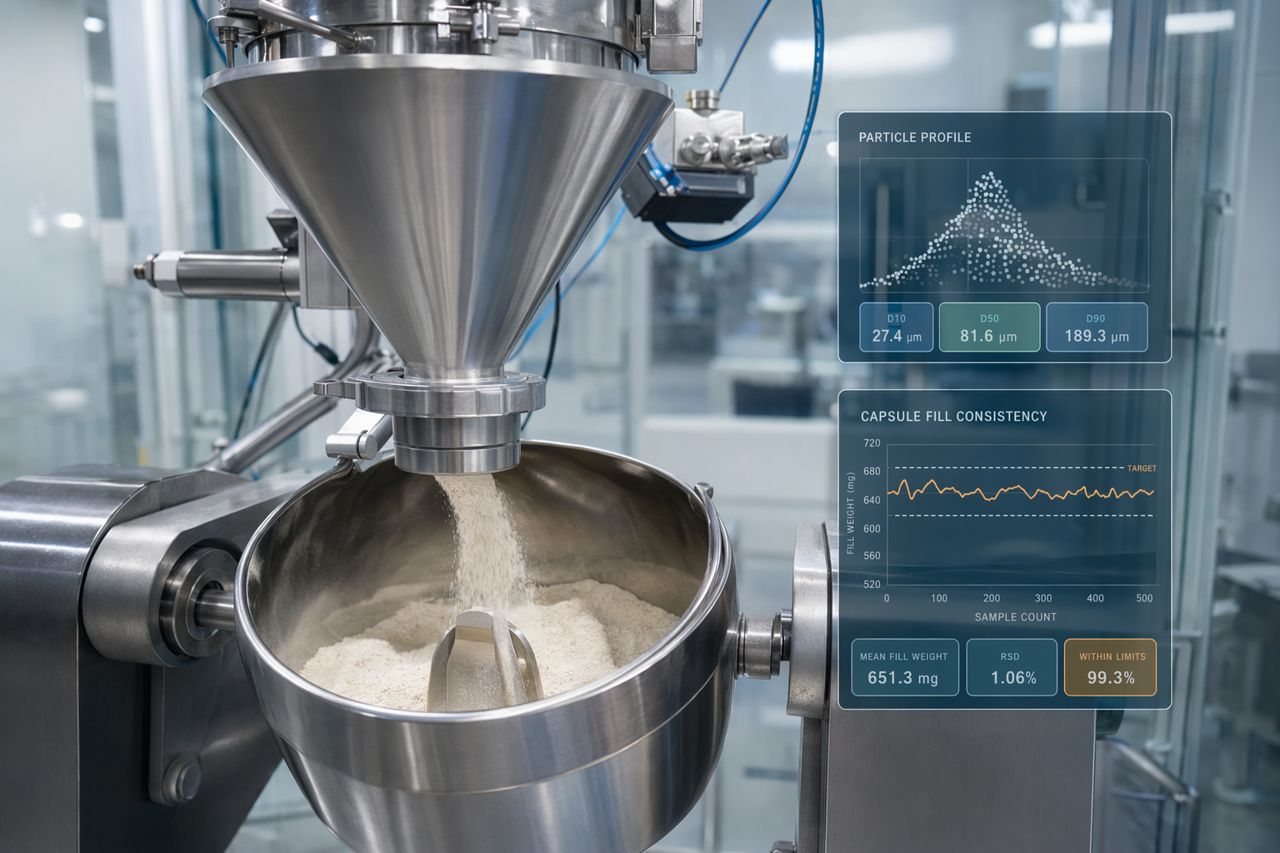
- Capsule fill-weight consistency
- Hopper behavior over the full run
- Environmental conditions during staging and filling
- Hold time between blending and encapsulation
- Lot-to-lot differences in enzyme input behavior
- Documentation completeness for quality review
A clean scale-up plan reduces late-stage troubleshooting and gives contract manufacturers clearer instructions for repeat production.
Documentation matters as much as powder behavior
For dietary supplement manufacturers, blend uniformity is both a technical and documentation concern. A well-built enzyme program should include raw material specifications, batch traceability, certificates of analysis, allergen statements, origin information, and change-control communication.
When documentation is incomplete or inconsistent, even a technically sound blend can slow down release, customer approval, or retailer compliance review.
CapsuleForge support for digestive enzyme capsule programs
CapsuleForge supplies bulk digestive enzyme solutions for supplement manufacturers developing capsule, tablet, powder, and functional blend formats. Our technical approach is formulation-led: we look at enzyme selection, powder compatibility, dosage format, sourcing consistency, and scale-up requirements together.
We can support teams that need:
- Single digestive enzyme ingredients
- Custom digestive enzyme blends
- Capsule-ready enzyme premixes
- Documentation packages for quality and regulatory review
- Lot consistency for repeat manufacturing
- Technical discussion around excipient compatibility and blend behavior
- Supply planning for pilot, launch, and commercial volumes
Request a quote
If you are developing or scaling a digestive enzyme capsule product, CapsuleForge can help evaluate ingredient fit, blend compatibility, documentation requirements, and commercial supply options.
Request a quote using the on-site form and include your target dosage format, capsule size if known, desired enzyme blend, label requirements, and estimated production volume.